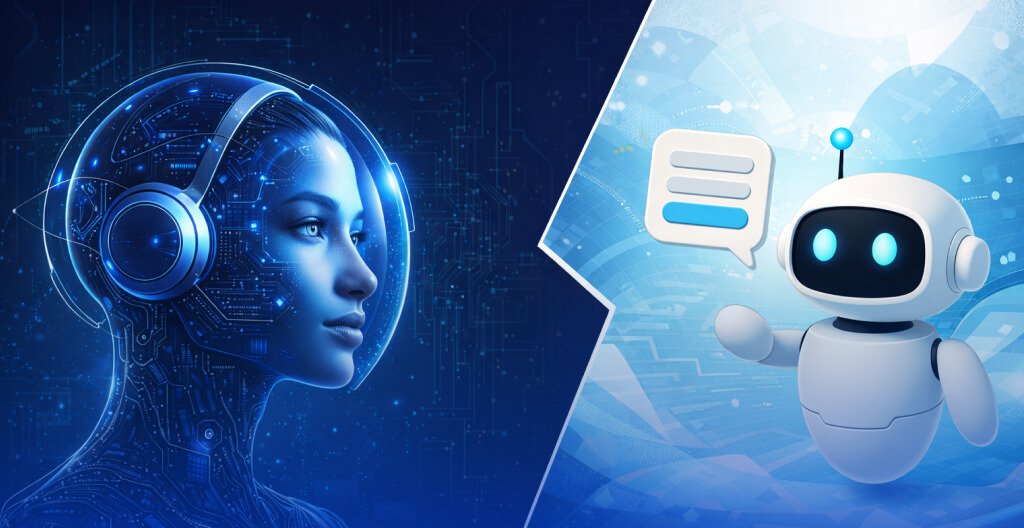

In today’s digital-first business environment, organizations are continuously seeking smarter ways to improve customer engagement, streamline operations, and accelerate growth. Conversational AI has emerged as a powerful enabler of this transformation, allowing enterprises to automate communication, reduce response times, and deliver consistent customer experiences at scale. Among the most widely adopted technologies in this space are AI agents and chatbots. Although these terms are often used interchangeably, they represent very different levels of intelligence, capability, and business value.
Many organizations find themselves asking whether they should invest in a virtual agent or a chatbot, and when each solution is the right fit. The answer depends on business complexity, automation goals, customer expectations, and long-term scalability. Understanding the difference between AI agents and chatbots helps businesses make informed decisions that directly impact operational efficiency, customer satisfaction, and return on investment. At Hutech Solutions, we help enterprises design and implement conversational AI strategies that align with real business outcomes and digital transformation goals.
Table of Content
Understanding Chatbots in Modern Business
A chatbot is a software application designed to simulate human conversation through text or voice interfaces. Traditional chatbots operate using predefined rules, scripts, and decision trees, allowing them to respond to specific keywords or structured queries. This makes them highly effective for handling predictable and repetitive interactions such as answering frequently asked questions, confirming bookings, providing order status updates, or collecting basic customer information.
For example, when a customer asks about business hours or delivery timelines, a chatbot can instantly provide the correct response without human involvement. This improves response speed and reduces support workload. However, when the conversation becomes more complex or requires contextual understanding, many chatbots struggle to deliver meaningful answers. Even AI-powered chatbots, while more flexible than rule-based bots, typically operate within limited boundaries and lack deep reasoning capabilities.
Despite these limitations, chatbots remain a valuable entry point for organizations beginning their automation journey. They are cost-effective, quick to deploy, and capable of managing large volumes of simple requests efficiently. Businesses often use chatbots to improve service availability, reduce wait times, and free human agents to focus on more strategic or complex tasks.
What Makes an AI Agent Different?
An AI agent represents a more advanced form of conversational intelligence. Unlike chatbots, AI agents leverage machine learning, natural language processing, contextual memory, and predictive analytics to understand user intent, learn from interactions, and make intelligent decisions in real time. Instead of simply responding to predefined commands, AI agents can analyze data, adapt to changing scenarios, and perform complex workflows autonomously.
When a user engages with an AI agent, the system can remember past interactions, preferences, and behavior patterns. This allows it to deliver personalized recommendations, anticipate user needs, and maintain meaningful conversations across multiple sessions. For instance, in an e-commerce environment, an AI agent can suggest products based on browsing history, previous purchases, and seasonal trends. In enterprise environments, AI agents can integrate with CRM, ERP, and analytics platforms to automate processes such as ticket resolution, reporting, onboarding, and decision support.
AI agents are proactive rather than reactive. They can initiate actions, send alerts, trigger workflows, and continuously improve their performance as more data becomes available. This makes them ideal for organizations that require advanced automation, personalization, and scalability across multiple business functions.
Difference Between AI Agents and Chatbots Explained
The primary difference between AI agents and chatbots lies in intelligence, adaptability, and scope of responsibility. Chatbots are designed to handle structured interactions within a limited framework, whereas AI agents are capable of managing dynamic, multi-step workflows that require reasoning and context awareness. Chatbots typically respond only when prompted by users, while AI agents can actively guide users, predict next steps, and automate downstream actions.
Another key distinction is memory and personalization. Chatbots generally operate within a single session and do not retain long-term context, resulting in repetitive or fragmented conversations. AI agents maintain contextual continuity, allowing them to deliver consistent and personalized experiences over time. Integration capability also differs significantly. Chatbots often function as standalone interfaces, while AI agents seamlessly connect with enterprise systems, enabling end-to-end process automation and data-driven decision-making.
From a business perspective, chatbots optimize operational efficiency at the surface level, while AI agents drive deeper digital transformation by automating complex processes and enabling intelligent insights.
Virtual Agent vs Chatbot: Functional Perspective
The term virtual agent is often associated with AI-powered conversational systems that deliver more advanced functionality than traditional chatbots. A virtual agent can handle transactions, manage workflows, and provide personalized guidance across multiple channels. While chatbots focus primarily on answering questions and guiding users through simple flows, virtual agents act as intelligent digital workers capable of executing business processes.
Virtual agents maintain conversation history, understand contextual intent, and proactively recommend actions based on predictive analytics. They also integrate deeply with backend platforms such as CRM systems, marketing automation tools, and enterprise databases. This allows organizations to deliver seamless customer journeys and operational continuity without manual intervention.
Understanding this distinction helps businesses determine whether a lightweight chatbot solution is sufficient or whether a more sophisticated virtual agent aligns better with long-term automation goals.
Business Benefits of AI Agents and Chatbots
Both AI agents and chatbots contribute significantly to business performance when implemented strategically. Chatbots improve responsiveness, reduce support costs, and handle repetitive tasks efficiently, ensuring consistent service availability around the clock. AI agents enhance customer experience through personalization, predictive engagement, and intelligent automation, enabling organizations to build stronger relationships with customers and partners.
From an operational standpoint, conversational AI reduces manual workload, accelerates service delivery, and improves accuracy. AI agents generate valuable insights from conversational data, allowing organizations to identify trends, optimize processes, and make informed strategic decisions. Cost savings, improved productivity, faster resolution times, and enhanced scalability collectively provide a strong competitive advantage in highly dynamic markets.
When to Use AI Agents vs Chatbots
The decision to use AI agents or chatbots depends largely on the complexity of interactions and business objectives. Chatbots are well-suited for high-volume, predictable tasks where speed and efficiency are the primary goals. They perform best in environments that require simple information exchange, basic support, and structured workflows.
AI agents are more appropriate when interactions involve personalization, decision-making, system integration, and long-term engagement. Organizations that require intelligent recommendations, workflow automation, advanced analytics, and proactive engagement benefit significantly from AI agents. Many enterprises adopt a hybrid approach, using chatbots for front-line interactions and AI agents for complex backend processes, ensuring both cost efficiency and high-quality service delivery.
How Hutech Solutions Enables Intelligent Automation
Hutech Solutions specializes in building scalable conversational AI solutions tailored to enterprise needs. Our AI engineers design secure architectures, integrate AI systems with existing platforms, and customize models to align with business workflows and compliance requirements. From chatbot deployment to advanced AI agent development, we ensure seamless implementation, continuous optimization, and measurable business impact.
By leveraging cloud infrastructure, advanced analytics, and industry best practices, Hutech helps organizations accelerate digital transformation while maintaining performance, reliability, and data security.
Implementation Challenges and Best Practices
Deploying conversational AI requires careful planning and execution. Integration with legacy systems, data privacy regulations, user adoption, and AI accuracy are common challenges. Organizations must prioritize data quality, governance, and security to ensure reliable performance and regulatory compliance.
Successful implementation starts with pilot projects, followed by gradual scaling based on feedback and performance metrics. Maintaining human oversight for sensitive workflows, continuously training AI models, and focusing on user experience design ensure long-term success and trust in AI-driven systems.
Future of AI Agents and Conversational AI
Conversational AI continues to evolve rapidly. Hyper-personalization, voice-enabled interfaces, emotionally intelligent AI, and autonomous workflow execution will shape the next generation of enterprise automation. Industry-specific AI agents will become increasingly common, delivering tailored capabilities for sectors such as healthcare, finance, logistics, and manufacturing. Human-AI collaboration will further enhance productivity by augmenting human decision-making rather than replacing it.
Conclusion
AI agents and chatbots each play a vital role in modern digital strategies. Chatbots provide fast, efficient automation for routine interactions, while AI agents enable intelligent, personalized, and scalable enterprise automation. Choosing the right approach depends on business maturity, operational complexity, and customer expectations.
With Hutech Solutions’ expertise in AI agent development services and conversational AI implementation, organizations can confidently adopt intelligent automation that drives growth, efficiency, and long-term competitive advantage.
Frequently Asked Questions
A chatbot responds to predefined commands and handles simple, repetitive tasks, while an AI agent can understand context, learn from interactions, and perform complex workflows proactively.
Chatbots are ideal for high-volume, predictable tasks such as FAQs, order status updates, or basic customer support where speed and efficiency are priorities.
AI agents enhance human support by automating routine or complex tasks, but human oversight is still essential for sensitive workflows or nuanced decision-making.
Hutech Solutions designs scalable conversational AI solutions, integrating AI agents with enterprise systems, customizing workflows, and ensuring continuous optimization for business impact.
MAIL US AT
sales@hutechsolutions.com
CONTACT NUMBER
+91 90351 80487
CHAT VIA WHATSAPP
+91 90351 80487
Humantech Solutions India Pvt. Ltd 163, 1st Floor, 9th Main Rd, Sector 6, HSR Layout, Bengaluru, Karnataka 560102