


As we step into 2026, enterprises are undergoing a fundamental transformation in how they operate, compete, and innovate. Artificial intelligence, automation, and data are no longer emerging technologies; they have become the core pillars of modern digital strategy. Organizations that successfully align these three forces are gaining real-time visibility, predictive intelligence, and operational agility that were once out of reach.
At Hutech Solutions, we see this convergence reshaping industries worldwide, from healthcare and logistics to finance and manufacturing, enabling enterprises to build intelligent, scalable, and future-ready systems.
In this evolving landscape, success depends not just on adopting new tools but on creating connected ecosystems where data flows seamlessly, automation operates intelligently, and AI continuously drives smarter decisions. This blog examines how AI, automation, and data are transforming enterprises in 2026 and how organizations can effectively navigate this shift.
Table of Content
Key Trends in AI, Automation, and Data for Enterprises
The convergence of AI, automation, and data is enabling intelligent systems that optimize every layer of enterprise operations. By 2026, enterprises will be shifting from reactive models to proactive, autonomous operations.
AI as the Strategic Engine
AI has evolved beyond dashboards and historical analytics. Today, it delivers predictive and prescriptive insights that guide business strategy, operational planning, and customer engagement.
In 2026, AI systems are increasingly acting as intelligent agents, capable of coordinating tasks across departments, from forecasting demand and detecting anomalies to optimizing resource utilization in real-time. When integrated with enterprise platforms, AI empowers leadership teams to move faster with greater confidence.
Hutech supports organizations in designing and deploying scalable AI solutions that integrate seamlessly with existing systems, ensuring accuracy, security, and measurable business impact.
Intelligent Automation Across Business Workflows
Automation is no longer limited to repetitive task execution. Enterprises are now embracing intelligent automation that combines robotic process automation (RPA), AI-driven decision logic, and workflow orchestration.
By 2026, agent-driven automation will become mainstream, enabling systems to autonomously manage complex processes such as financial operations, compliance monitoring, IT service management, and supply chain coordination. These intelligent workflows reduce manual dependency, enhance accuracy, and accelerate turnaround times.
Hutech helps enterprises architect automation frameworks that improve operational efficiency while maintaining governance and scalability.
Data as the Foundation for Enterprise Intelligence
Data remains the backbone of digital transformation. However, modern enterprises no longer treat data as static assets stored in silos. Instead, they invest in real-time pipelines, governed analytics platforms, and intelligent data management frameworks.
High-quality, trusted data ensures AI systems deliver reliable insights while enabling teams across business functions to make informed decisions. Strong data governance, lineage tracking, and continuous quality monitoring are essential to maintaining enterprise trust.
Hutech delivers end-to-end data engineering and analytics solutions that empower organizations to unlock the full value of their data securely and responsibly.
Traditional vs Intelligent Enterprise Model
In a traditional enterprise model, decision-making relies heavily on manual reports and historical data analysis. Insights often arrive late, making organizations reactive rather than proactive. In contrast, modern intelligent enterprises leverage AI-driven analytics and real-time data to generate predictive insights, enabling faster, more accurate, and strategic decisions.
Workflow efficiency in traditional organizations is often limited by siloed systems and manual handoffs between teams, which slows down operations and increases errors. An AI, automation, and data-driven approach connects workflows end-to-end through intelligent automation, improving speed, transparency, and operational consistency.
Data management in traditional environments depends on static databases and delayed updates, which restrict real-time visibility and scalability. Intelligent enterprises use real-time data pipelines with governed analytics to ensure continuous access to accurate, secure, and actionable data across the organization.
Risk management is typically reactive in legacy models, where issues are addressed only after they occur. With AI-powered systems, organizations can proactively detect risks, predict potential failures, and automatically trigger remediation actions, significantly improving resilience and compliance.
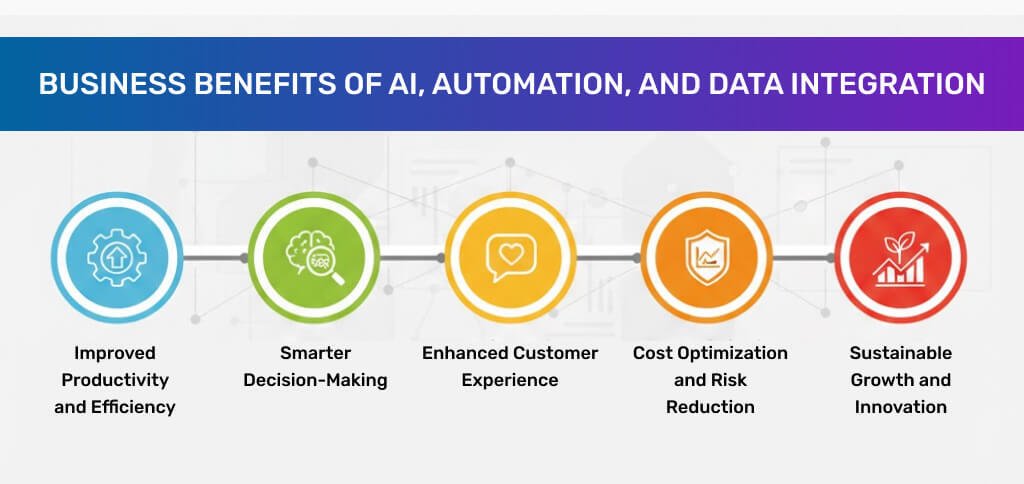
Business Benefits of AI, Automation, and Data Integration
Enterprises that integrate AI, automation, and data effectively gain measurable competitive advantages:
Improved Productivity and Efficiency
Routine tasks are automated, allowing teams to focus on strategic initiatives, innovation, and customer value.
Smarter Decision-Making
Predictive analytics improves forecasting accuracy, optimizes resource allocation, and reduces operational risk.
Enhanced Customer Experience
Personalized digital interactions improve engagement, retention, and brand loyalty.
Cost Optimization and Risk Reduction
Automated monitoring and analytics improve cost control, security posture, and compliance readiness.
Sustainable Growth and Innovation
Intelligent systems enable energy optimization, smarter logistics, and scalable digital business models.
These capabilities position enterprises to scale confidently while maintaining agility in rapidly evolving markets.
Challenges in Enterprise Adoption
Despite the benefits, organizations must address key challenges when adopting AI, automation, and data strategies.
Data Governance and Quality
Inaccurate or fragmented data can undermine AI outcomes. Strong governance frameworks, security controls, and regulatory compliance are essential.
Ethical AI and Cybersecurity
Enterprises must ensure transparency, fairness, and accountability in AI systems while strengthening cyber resilience against evolving threats.
Workforce Enablement
The shift toward intelligent systems requires upskilling employees in data literacy, AI operations, and digital collaboration.
Best Practices to Address These Challenges:
- Establish enterprise-wide data governance models
- Implement responsible AI frameworks
- Invest in continuous learning and change management
Align automation initiatives with business KPIs
What 2026 Holds for Enterprises
Autonomous Operations
AI-powered systems will increasingly self-optimize and self-correct, improving resilience and operational excellence.
Platform-Oriented Orchestration
Enterprises will unify AI tools and automation layers into centralized platforms for better governance and scalability.
Responsible Innovation
Sustainability, security, and ethical AI will become embedded in enterprise technology strategies.
Conclusion
The synergy of AI, automation, and data is redefining enterprise transformation in 2026. Organizations that integrate these capabilities strategically will gain the intelligence, speed, and adaptability needed to lead in competitive markets.
At Hutech Solutions, we partner with enterprises to design, build, and scale intelligent digital solutions, from AI engineering and automation platforms to cloud transformation and data analytics. By aligning technology with business objectives, we help organizations transform complexity into opportunity and build future-ready operations.
Frequently Asked Questions
AI, automation, and data are enabling enterprises to operate intelligently by automating workflows, delivering predictive insights, improving decision-making, and optimizing operational efficiency across departments.
Intelligent automation combines RPA, AI-driven decision-making, and workflow orchestration to manage complex business processes autonomously, improving speed, accuracy, and scalability.
Strong data governance ensures data accuracy, security, compliance, and reliability, allowing AI systems to generate trustworthy insights and reduce operational risks.
Common challenges include poor data quality, cybersecurity risks, ethical AI concerns, integration complexity, and workforce skill gaps.
MAIL US AT
sales@hutechsolutions.com
CONTACT NUMBER
+91 90351 80487
CHAT VIA WHATSAPP
+91 90351 80487
Humantech Solutions India Pvt. Ltd 163, 1st Floor, 9th Main Rd, Sector 6, HSR Layout, Bengaluru, Karnataka 560102