

The Challenge of Modern Cyber Threats
Today, cyber threats don’t arrive as single, isolated incidents. Instead, they operate continuously, adapt quickly, and often remain hidden until damage is already done. Meanwhile, large enterprises manage sprawling digital ecosystems comprising cloud platforms, APIs, endpoints, SaaS tools, and hybrid infrastructure. As a result, the attack surface has expanded significantly—one that traditional, rule-based security tools can no longer keep up with.
At the same time, security teams are overwhelmed with alerts, false positives, and fragmented visibility. Moreover, attackers are increasingly using automation and AI to accelerate reconnaissance, exploit vulnerabilities, and bypass detection. Consequently, this growing imbalance has pushed organizations to rethink how cybersecurity operates. For this reason, enterprises are moving away from purely reactive security models. Instead of responding after an incident occurs, organizations are adopting agentic AI cybersecurity systems that can think, act, and adapt on their own. As a result, agentic AI is becoming a critical layer in modern threat detection, helping security teams move faster, reduce noise, and respond before threats escalate.
Table of Content
What Is Agentic AI in Cybersecurity?
Agentic AI refers to autonomous AI systems composed of multiple intelligent agents that can observe their environments, make decisions, take actions, and improve over time. In practice, within cybersecurity, this approach goes far beyond traditional log analysis or basic alert generation.
Specifically, agentic AI systems actively:
Continuously monitor activity across networks, cloud workloads, identities, and APIs
Proactively detect unusual or risky behavior in real time
Simultaneously correlate signals from multiple sources
Contextually decide on appropriate responses based on real-world conditions
Autonomously execute actions without waiting for human input
In contrast, traditional AI tools depend heavily on fixed rules or known signatures. However, agentic AI adapts continuously as environments and threats evolve. Over time, it learns from new attack techniques and collaborates across the security stack. As a result, this shift enables organizations to move from reactive security toward proactive and predictive defense.
Why Enterprises Need Agentic AI for Threat Detection?
Today, enterprise security teams are facing a perfect storm. As infrastructure becomes more distributed, threats move faster, and at the same time, skilled security professionals remain in short supply. Consequently, traditional SOC models struggle with alert fatigue, slow investigations, and delayed response times.
To address this gap, agentic AI plays a critical role. By design, autonomous security agents operate around the clock, continuously identifying threats, prioritizing risks, and responding in seconds rather than hours. As a result, large organizations can stop lateral movement earlier, contain breaches faster, and ultimately reduce operational overhead.
In this way, agentic AI acts as a force multiplier. Instead of chasing alerts, security teams can focus on higher-value strategic decision-making and long-term risk management.
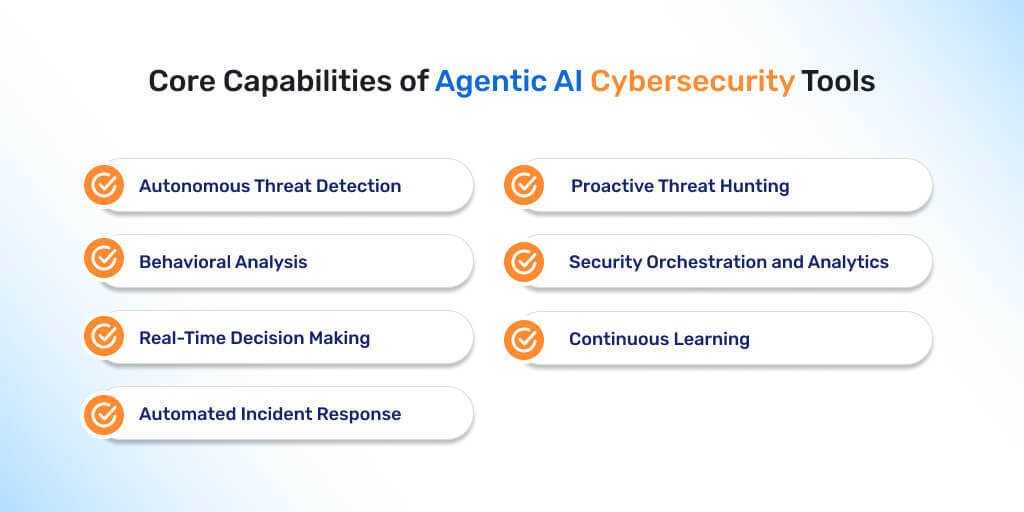
Core Capabilities of Agentic AI Cybersecurity Tools
Autonomous Threat Detection
Continuously monitors endpoints, networks, cloud workloads, APIs, and identities to identify suspicious behavior in real time, without relying solely on static rules.
Behavioral Analysis
Builds dynamic baselines for users, applications, and systems to detect insider threats, zero-day attacks, and subtle anomalies.
Real-Time Decision Making
Assesses context and severity instantly, enabling faster and more accurate response actions.
Automated Incident Response
Executes actions such as isolating systems, blocking traffic, revoking access, and triggering remediation workflows automatically.
Proactive Threat Hunting
Searches for hidden or dormant threats across environments instead of waiting for alerts to surface issues.
Security Orchestration and Analytics
Correlates data from multiple tools to uncover attack patterns and coordinate responses across the security ecosystem.
Continuous Learning
Adapts to new threats and attack techniques, improving accuracy and effectiveness over time.
Top Agentic AI Tools for Threat Detection
Based on real-world enterprise adoption and security architecture experience, the following platforms stand out in the agentic AI cybersecurity space.
CrowdStrike Falcon
CrowdStrike Falcon uses AI-driven indicators of attack to detect threats that bypass traditional signature-based tools. Its agentic capabilities analyze large volumes of telemetry to uncover lateral movement, fileless attacks, and identity-based threats across endpoints and cloud environments.
Darktrace
Darktrace is known for its self-learning AI that builds behavioral models for users, devices, and networks. It excels at identifying subtle anomalies, insider threats, and zero-day attacks by detecting deviations from normal behavior rather than relying on known patterns.
AccuKnox AI CoPilot
AccuKnox AI CoPilot focuses on cloud-native and Kubernetes security. It continuously assesses risk across workloads, identities, and runtime activity. Its agentic approach supports proactive testing and detection of misconfigurations and exploitable paths in modern cloud environments.
SentinelOne
SentinelOne offers fully autonomous detection and response. Its AI agents not only identify threats but also take corrective actions such as killing malicious processes, repairing damage, and rolling back changes, significantly reducing response time.
Palo Alto Networks Cortex XSIAM
Cortex XSIAM is designed to modernize SOC operations using AI-driven automation. It correlates data across endpoints, logs, network traffic, and cloud platforms, enabling faster investigations and more efficient incident response.
Akto
Akto focuses on API and AI security with an emphasis on autonomous testing. Its agentic AI helps detect emerging risks such as insecure APIs, prompt injections, and unsafe interactions between AI agents, making it especially relevant for organizations building AI-powered applications.
Prophet Security
Prophet Security introduces the concept of an AI SOC analyst. It automates investigations, enriches alerts with context, and prioritizes incidents based on impact, helping teams reduce alert fatigue while maintaining accuracy.
Dropzone AI and Torq
These platforms specialize in SOC automation and orchestration. They enable autonomous alert handling, workflow execution, and response coordination across multiple security tools, supporting highly scalable SOC environments.
Agentic AI for Cloud and Brand Protection
Agentic AI is also playing an increasingly important role in areas such as cloud security and brand protection. In practice, AI agents continuously assess cloud configurations, proactively detect identity abuse, and simultaneously monitor APIs for misuse. Similarly, for brand protection, agentic systems track phishing domains, fake social media accounts, and impersonation attempts, thereby initiating takedowns or alerts automatically.
As a result, this broader visibility enables organizations to protect not only their infrastructure but also customer trust and overall brand reputation.
Build vs Buy: Choosing the Right Approach
Enterprises must decide whether to adopt off-the-shelf agentic AI platforms, build custom solutions, or combine both approaches. Commercial tools offer faster deployment and proven capabilities, while custom development allows deeper integration and alignment with internal systems.
Many organizations choose a hybrid model, using established platforms for core security functions and building specialized AI agents for high-value use cases.
Conclusion
Cybersecurity is no longer a purely human-driven function. As threats become faster and more automated, defense systems must do the same. Agentic AI cybersecurity represents a shift toward intelligent, adaptive protection that operates at machine speed.
Enterprises that adopt agentic AI tools today gain stronger visibility, faster response, and better resilience against evolving threats. Those that rely solely on manual processes and static tools risk falling behind in an increasingly automated threat landscape.
Frequently Asked Questions
Agentic AI uses autonomous agents that can observe, decide, act, and learn continuously to detect and respond to cyber threats.
Traditional tools rely on rules and known signatures, while agentic AI adapts dynamically and responds to new, unknown threats in real time.
No. It augments security teams by automating detection and response, allowing analysts to focus on strategic and complex tasks.
Yes. Agentic AI is particularly effective in dynamic, cloud-native, and multi-cloud environments.
MAIL US AT
sales@hutechsolutions.com
CONTACT NUMBER
+91 90351 80487
CHAT VIA WHATSAPP
+91 90351 80487
Humantech Solutions India Pvt. Ltd 163, 1st Floor, 9th Main Rd, Sector 6, HSR Layout, Bengaluru, Karnataka 560102